
Government versus opposition, conservatives versus left-liberals, urban versus rural: Hungary’s society is deeply divided, not least when it comes to the war in Ukraine. The major national holidays in 2025 have underscored both internal conflicts and problematic external relations.
Introduction
Postcommunist Hungary has two public holidays that commemorate the sacrifices made in the past to secure independence in the present. On March 15th the nation remembers the anti-Habsburg “freedom fight” (szabadságharc) of 1848-49. On October 23rd citizens celebrate the 1956 uprising against Soviet communism. Both movements, albeit unsuccessful in the short term, are considered to be revolutions. Viktor Orbán, leader of the Fidesz party and prime minister since 2010, uses these national holidays to mobilize his supporters and deliver emotive speeches highlighting national sovereignty. In the complex geopolitical constellation of 2025, with parliamentary elections pending in April 2026, this required more skill and chutzpah than ever before.
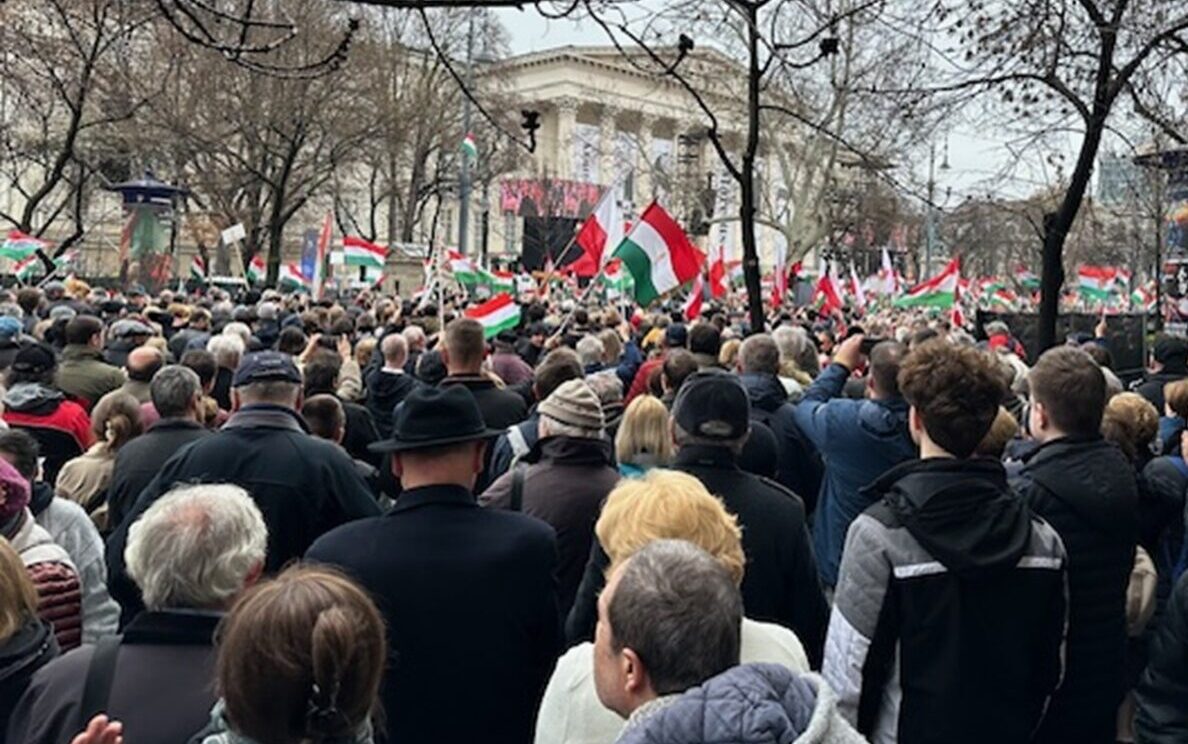
Orbán’s speech on the steps of the national museum on 15th March called out the EU Commission in Brussels (not for the first time) as the imperialist power that was oppressing the Hungarian people.1 The EU was also setting out to colonize Ukraine, while the economic cost of this expansion would be borne by Hungarians. This speech was also notable for labelling domestic political opponents as “bugs” to be eliminated in the course of spring cleaning. Péter Magyar, leader of the Tisza party, who has emerged from nowhere to become Orban’s principal rival in recent years, drew a similarly large crowd to his own celebratory event later in the day.
Seven months later, with the Hungarian economy increasingly fragile, Tisza was still ahead of Fidesz in most opinion polls. Orban’s response in his speech on 23rd October was to double down on the war in Ukraine as the key issue separating the policies of his government from those of his opponents, at home and abroad. Ukraine has become a lightning rod in a thoroughly polarized country. Urbanites, especially in cosmopolitan Budapest, tend to share the mainstream western perception that Kyiv has a charismatic president (Volodymyr Zelensky) who leads a united nation fighting for noble causes: independence, freedom, pluralist democracy. These are the causes that Hungarians themselves have fought for over centuries. However, large sections of Hungarian society sympathize with the vilifying representations of state media; they view Ukraine as mired in corruption and an existential threat. This post probes the tensions as they manifested themselves on 1956 Revolution Memorial Day.
The context
In all the diplomatic manoeuvring since Donald Trump returned to the White House, one European state has consistently resisted the continent’s dominant trends. Hungary joined NATO in 1999 and the EU in 2004. However, while the rest of Europe frets whenever Washington declines to meet Kyiv’s military needs as requested, Viktor Orbán salutes Trump as the statesman who is committed to peace. Poland, Hungary’s erstwhile close ally, together with most other postsocialist states has joined the British-led “coalition of the willing” ready to ramp up military support for Ukraine, independently of Washington if need be. The government in Budapest accuses them all of warmongering. Its call for peace is motivated, of course, not solely by humanitarian ideals but also by energy dependencies (Slovakia is similarly vulnerable but smaller and less courageous in resisting the EU mainstream), by fears for what the rapid integration of Ukraine into the EU would mean for Hungarian agriculture, and last but not least party-political strategizing ahead of the elections.
Given widespread international agreement that Orbán’s authoritarian regime has long descended into illiberalism and corruption, its distinctive peace policy falls flat. If anything, it has the contrary effect: sanctions on Russia should indeed be further tightened, and ever more sophisticated missiles sent to Ukraine. Across the EU and in Britain, both Orbán and Trump are widely perceived as shameless pragmatists by politicians and publics for whom the moral high ground lies unambiguously with Volodymyr Zelensky. The war in Ukraine is perceived in black and white terms, legally and ethically, that leave no room for compromise. So when Trump announced (on 16th October) an early meeting with Putin in the EU’s pariah state, Sir Keir Starmer and his coalition partners hastened to reassure Zelensky of their boundless support.
That meeting was postponed (or cancelled, depending on which media one reads) on the eve of 1956 Revolution Memorial Day. Moscow is insisting on preconditions and Trump is loath to “waste” a summit. It may never take place. But a summit in Budapest that put an end to the bloodshed and to the grotesque military escalation currently taking place across the old continent would be good news for humanity. Even if such a summit does takes place before the forthcoming Hungarian elections, there is no guarantee that it would suffice to keep Viktor Orbán in power.
A polarized society
Meanwhile it is instructive to consider the window the Russo-Ukrainian war provides into the current divisions in Hungary. Officially classified as “counterrevolution” throughout the long domination of first secretary János Kádár, since early 1989 the anti-communist uprising of 1956 has been securely inscribed in Hungary’s long tradition of fighting for freedom. In a seamless autumnal transition, the public holiday of 7th November commemorating the Great October Revolution was abolished and replaced with a holiday on 23rd October, the day on which the decisive phase of the fighting began in 1956. From its introduction, this celebration has foregrounded the nation and anti-communist sentiment, which for most of the population meant the repudiation of Russia.
When I lived in a Hungarian village in the 1970s, several teachers (not all) were members of the Communist Party. They explained the Great October Revolution to their pupils in line with the ideology of that era. Everyone had a day off school and work, but the holiday was not marked by any public rituals. The village of Tázlár lacked any form of socialist monument.
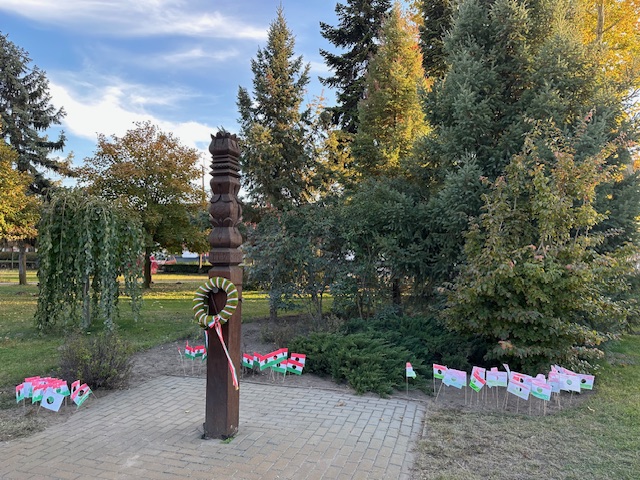
Things are different nowadays. The central park has a prominent carved wooden pole (kopjafa) to commemorate the sacrifices made in 1956. Teachers lead their pupils here on October 22nd to plant small flags. A new memorial close by lists all the villagers deported to the Soviet Union in the wake of the Second World War.
One of the teachers also serves as mayor of the village. A member of Fidesz, he explained to me how important it was to secure a good turnout in the Peace March scheduled for the morning of October 23rd in central Budapest. Not only would he and his wife be driving up to the capital by car: he had organized a bus to transport other villagers keen to take part.
Orbán’s Peace Marches, mass demonstrations in support of the government, have been gathering momentum in recent years. The marches always culminate with a major speech by the leader. In 2025 this took place against the backdrop of the magnificent parliament, in Kossuth Square. Lajos Kossuth was the greatest of the 19th century freedom fighters, when the Habsburgs were the enemy. Orbán again chose to focus on the imperial power of Brussels, which was rushing headlong into military escalation against Russia and implementing economic policies that were already driving down living standards for ordinary Hungarians. The Hungarian people cared passionately about freedom, and Budapest would be the capital of peace. Hungarians had a right to live and they were not prepared to sacrifice their lives for Ukraine!2
Of course, every word uttered by Viktor Orbán in these months must be interpreted in the context of the forthcoming elections. Some of his anti-Ukrainian rhetoric is far-fetched, bordering on the hysterical. But many observers agree that the admission of Ukraine to the EU would indeed further diminish the resources available to support Hungary’s stuttering economy. Many citizens are appalled by the manner in which ethnic Hungarians from Transcarpathia are conscripted to fight against Russians on the frontlines in the east.
Péter Magyar, Orbán’s only credible challenger, is careful not to distance his Tisza party too far from Orbán’s conservative nationalism. Magyar’s support for Ukrainian accession, expressed in the European Parliament, allows Orbán to caricature him as a puppet of the Brussels Commission. With the electoral campaign gathering steam, rival commemorations on 23rd October revealed the extent of the country’s polarization. Opposition leaders asserted that their “national” march to Heroes Square attracted many more supporters than the participants in Orbán’s “peace” march earlier in the day. Orbán’s media claimed that he had mobilized far more citizens and delivered by far the more powerful speech.3
Families have been torn apart by this polarization. Through his control over the state media and elaborate poster campaigns, Orbán has disseminated representations of Ukraine as a swamp of mafia-like corruption. The nationalism of the regime in Kyiv is illustrated with restrictions on the cultural life of the country’s Hungarian minority, and its brutality graphically revealed with footage of the violent conscription of young men attempting to evade the draft. These stereotypes are widespread, especially in smaller settlements. In central Budapest the atmosphere is different: here restaurants and Bierkeller display the Ukrainian flag to indicate solidarity in much the same way one finds in western countries.
Interpretations and reflections
In view of the fact that anti-Russian sentiment still runs deep in Hungarian society, the entrenchment of the anti-Kyiv narrative as a complement to the anti-Brussels narrative is a puzzle. Memories of the violence and deportations that followed the arrival of the Red Army in 1944 have been retrieved and cultivated since the collapse of socialism. Many Hungarians can recall the chequered history of peace initiatives in the socialist period, when “peace priest” was a term of abuse for clergy who undermined their churches by forging common causes with the Communist Party. The key slogan of the 1956 revolution was “Russians go home,” words that Orbán himself echoed in 1988 as a radical student leader. But by 2025 he and his allies were stressing that their opposition had always been to Soviet ideology rather than to the Russian people.
In this complex situation, it is important to remember that most educated Hungarians have access to media not under Viktor Orbán’s control, inside and outside their country. The perfidy of their government is increasingly acknowledged. People make embarrassed jokes about the state of the nation when talking with a foreigner like myself. Péter Magyar and other opposition leaders allege continuous manipulation on a par with the manipulation of peace movements by the Communist Party in the last century.
But it would be wrong to dismiss Fidesz mayors like my friend in Tázlár as ignorant, bamboozled or manipulated. Liberal cosmopolitans in the capital should not doubt the sincerity of villagers who give up their holiday in order to make their presence felt at the centre of their polity.
Living in a bitterly polarized society, exposed daily to starkly opposed narratives, Hungarians may be in a better position than most other Europeans to question the simplistic representations that have characterized western media coverage of Ukraine since the war began.
Epilogue
Shortly after the latest jousting with Péter Magyar, Viktor Orbán travelled to Washington for an audience with Donald Trump. After this meeting, Orbán continued to insist that the peace summit had not been cancelled, only postponed. It was just about possible to tell his domestic audiences that a one-year exemption from US sanctions on Russian energy was a diplomatic triumph. In return, however, Hungary has committed to importing not only LNG but also nuclear fuel rods from the USA.4 Freedom and sovereignty are words of easy virtue – but subordination to the alleged imperialism of Brussels appears now to have been replaced by total political and economic dependence on Washington.
- https://miniszterelnok.hu/en/speech-by-prime-minister-viktor-orban-on-the-177th-anniversary-of-the-hungarian-revolution-and-war-of-independence-of-1848-49/. Orbán asserted that “… there is always an empire that seeks to take the freedom of the Hungarians. Right now it is one in Brussels. Brussels is abusing its power, just as Vienna did in its time.” [↩]
- https://miniszterelnok.hu/en/speech-by-prime-minister-viktor-orban-on-the-69th-anniversary-of-the-1956-hungarian-revolution-and-freedom-fight/. This speech included the remarkable statement: “If Brussels had not obstructed the American president’s peace mission, the war would already be over.” Orbán proceeded to appeal to his audience as follows: “We are now a strong and sovereign nation of dignity, which will preserve itself and its future, no matter how much the traitors howl “Slava Ukraini!” Our only response to that is, “Dicsőség Magyarországnak!” [“Glory to Hungary!”] Those who say “no” to war are with us.” [↩]
- The German journalist who covers Hungary for Deutsche Welle reported that the opposition had won by two to one, but this seemed implausible to me. See Keno Verseck: https://www.dw.com/de/ungarns-nationalfeiertag-wird-zum-magyar-orban-schaukampf/a-74481607 [↩]
- https://www.bbc.co.uk/news/articles/ckg4r193152o [↩]


Kommentare von Chris Hann