
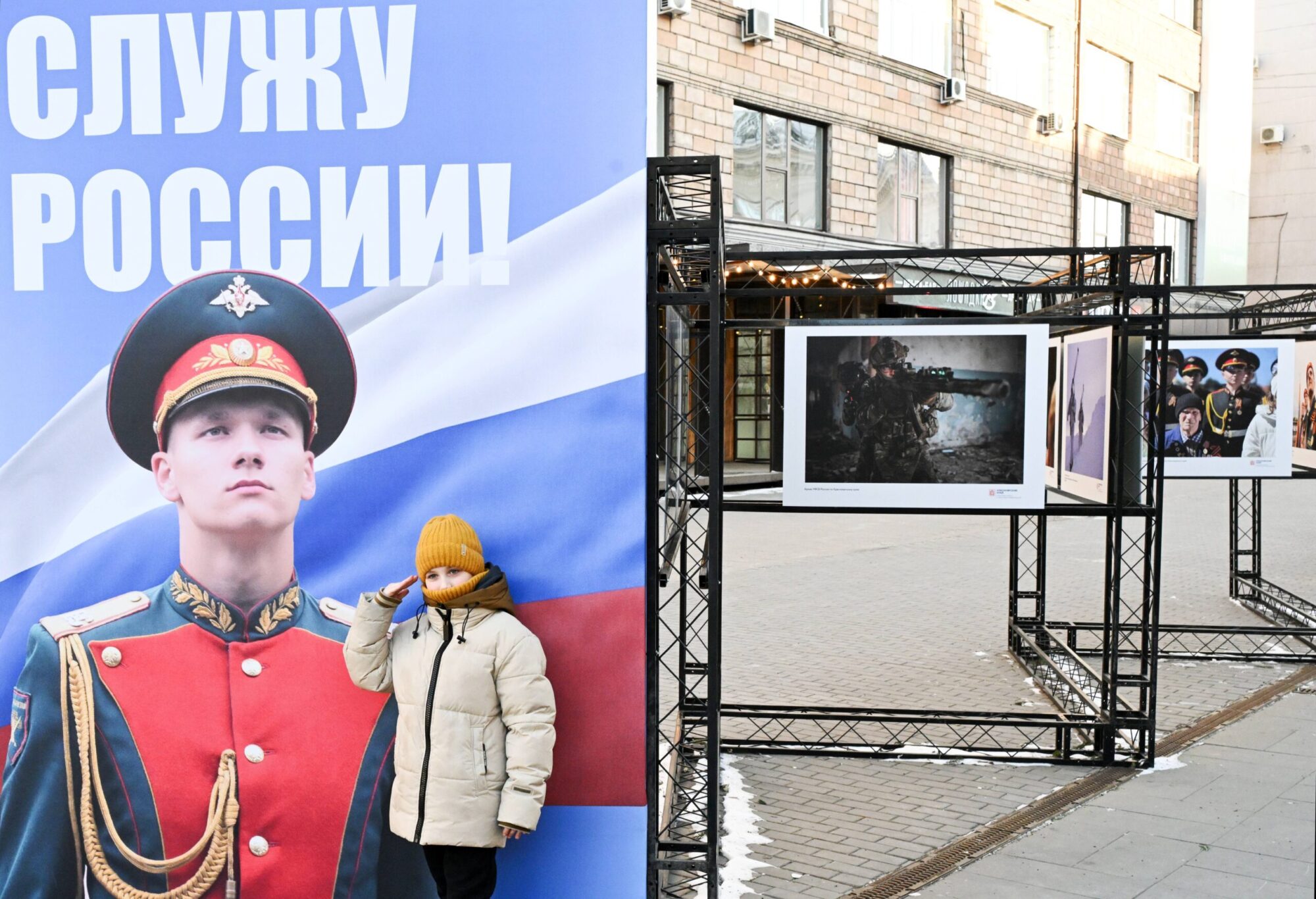
Russia may soon cross a demographic “point of no return”. Several negative developments are unfolding simultaneously – partly intensified by Putin’s policies: a deteriorating age structure, consequences of the war, economic contraction, and shrinking migration flows. This could result in Russia experiencing a substantial and almost irreversible population decline.
Since the start of the full-scale invasion of Ukraine, Russia has simultaneously been undergoing a fundamental change in its population structure: Small cohorts born in the 1990s and early 2000s are now entering their prime working and reproductive years, while large post-World War II generations are retiring. Meanwhile, sanctions, technological isolation, and labour shortages are weakening the Russian economy and limiting the government’s fiscal capacity. As economic growth slows, the state’s ability to finance expensive pro-natalist policies or effective mortality reduction diminishes.
War amplifies these structural weaknesses. Direct deaths, uncertainty, and emigration – especially of educated young people – depress fertility and erode long-term human capital. Rising xenophobia and restrictive migration policies further reduce Russia’s attractiveness to migrants. The eventual return of combatants is likely to result in higher alcohol abuse, crime, domestic violence, and a broader decline in the perceived value of human life.
Over the next ten years, these processes could become self-sustaining: depopulation weakens the economy; a weaker economy limits demographic policy; social deterioration drives further outmigration and deters newcomers.
Mortality: direct and indirect losses
Reliable demographic data from Russia have become scarce. In 2025, the governmental statistics agency Rosstat effectively stopped publishing detailed information,1 forcing reliance on independent estimates. In particular, war casualties are treated as state secret, yet it is obvious that the numbers are staggering. Based on open-source analysis, Mediazona, the BBC Russian Service, and Meduza estimate that there have been no fewer than 200,186–219,000 military fatalities as of 24 February 20262. Some other credible media outlets report even higher numbers. For each soldier killed, at least two to three more are seriously wounded and unable to work, either partially or fully. These losses concentrate among men aged 21 to 47. Roughly one in twenty within this cohort has been killed or incapacitated. This group forms the core workforce and primary pool of potential fathers. Such losses likely reduce economic output for decades (as the productive base shrinks) and exacerbate father deficits in already small cohorts.
Indirect losses may be equally significant. The return of veterans increases the risk of substance abuse, violence, accidents and suicides. Sanctions and fiscal constraints also limit access to advanced medical technologies and imported medicines, while staff shortages put pressure on the healthcare system. Mortality from cardiovascular diseases and cancers among working-age adults may increase, and gains in male life expectancy could stagnate or reverse.
Age structure and demographic waves
Russia’s age pyramid reflects the catastrophes of the 20th century – two world wars, a civil war, famines, Stalinist terror – whose long-term effects persist in 25–30-year demographic waves. The most recent echo followed the USSR’s collapse: the small generation born in the late 1990s and early 2000s is now entering prime working and reproductive ages, constraining both labour supply and fertility.
According to calculations based on Rosstat’s medium forecast (2023), between 2012 and 2032 the number of people aged 20–39 will decline by about 13 million (roughly one-third), while those aged 60+ will increase by about 13.4 million (around one-half). Population ageing accelerates, and the dependency burden on workers rises.
This narrowing base explains why Russia had few births in 1999 (small cohorts entering reproductive age) but many in 2016 (larger post-WWII echo), and why 2022 marked a particularly vulnerable turning point amid the invasion.
Fertility and the limits of policy
Russia recorded 1.21 million births in 1999. By 2016, this figure had risen to 1.89 million, but by 2024 it had fallen back to around 1.22 million – close to the previous historic low – and the decline continues. Even if the total fertility rate (TFR) – i.e. births per woman – stabilises, the absolute number of births will fall as smaller cohorts of women reach childbearing age (Fig. 1). In order to maintain even 1.2–1.3 million births annually, the TFR would need to rise from about 1.4 to 1.7–1.8 and remain at this level until the mid-2030s, which is an unlikely scenario. Otherwise, the demographic ‚echo‘ will repeat in 25–30 years, producing another generation 25–30% smaller than its parents.

Historically, the state has lacked the will to take corrective action; today, it also lacks the means to do so. Effective pro-natalist policy is expensive. OECD experience suggests spending of at least 3% of GDP on family benefits and childcare support;3 the OECD average exceeds 2%. Russia spends around 1%.4 Amid deficits and military prioritisation, substantive family policy is increasingly being replaced by restrictive reproductive initiatives and ideological campaigns –measures that cannot substitute for economic security and social infrastructure.
Shrinking net migration
Since 1992, migration has been the main buffer against natural population decrease. From 1992 to 2023, the total natural decline was 16.8 million, while net migration reached 12.3 million, covering nearly three-quarters of the losses. However, this mechanism is weakening.
In 2022, large-scale wartime emigration included many young professionals,5 reducing both current labour supply and future demographic potential. At the same time, inflows are shrinking. Economic growth in countries of origin has narrowed income gaps with Russia (especially Central Asia) (https://data.worldbank.org/indicator/NY.GDP.MKTP.KD.ZG), while alternative destinations such as Turkey, the Gulf, the EU and South Korea remain attractive due to persistently higher wages, thereby increasing incentives to migrate there instead of Russia.
Domestic factors compound this trend. The rise in public hostility towards migrants since the start of the full scale invasion and anti-immigrant measures following the terrorist attack at Crocus City Hall in 2024, including increased deportations, signal a restrictive turn of state policy towards immigration.6 The new State Migration Policy Concept frames migration primarily through national security rather than demographic compensation or economic gain. Thus, net migration could approach zero or become negative.7
Long-term trajectories
Demographers estimate that absent 20th-century wars, famines, and repression, Russia’s population today might have reached 250–270 million rather than the current 140+ million.8 Despite population growth through most of the 20th century (albeit below potential), absolute decline set in from the 1990s – a pattern the current crisis perpetuates. Figure 2 illustrates the UN World Population Prospects 2024 medium and low variants (solid lines, with net migration) versus my zero-migration modifications (dashed lines, net migration set to zero from 2025–2100); I exclude high variants as unrealistic due to implausibly high fertility assumptions even without war. Under the zero-migration medium scenario, Russia’s population could fall to 89.6 million by 2100 (versus 126.4 million in the medium variant); the low variant allows for 58.3 million people (Fig. 2).9
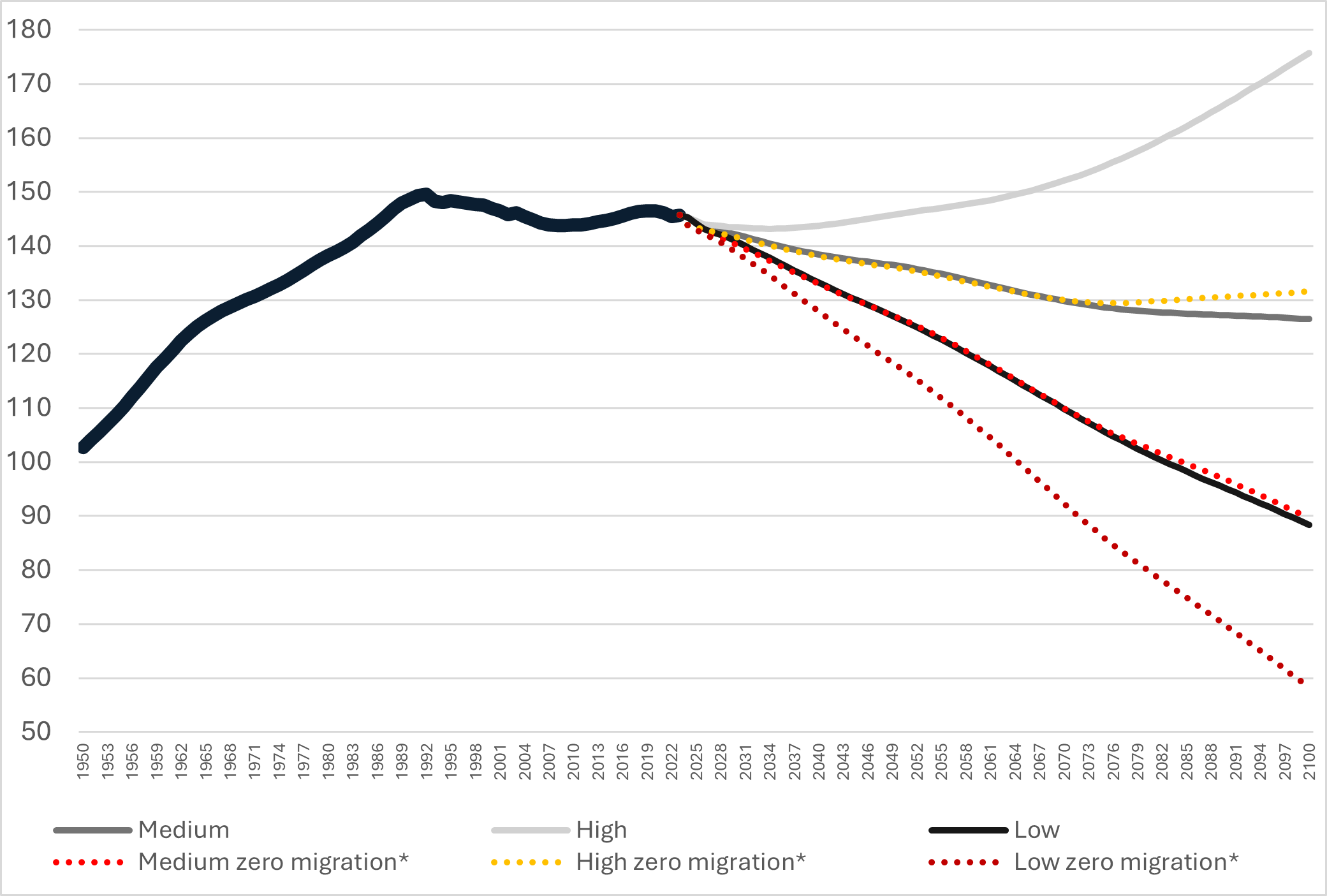
*Zero-migration variants calculated by the author based on WPP-2024
The leadership is aware of these risks. In 2012, Vladimir Putin warned that without a long-term demographic strategy, Russia could become an “empty space”.10 Yet current policies increase the likelihood of exactly this scenario.
Demographic processes are highly inertial. Contraction in reproduction and labour supply has entered an accelerated phase. The convergence of structural ageing, war-related losses, economic constraints, and declining migration may entrench a trajectory that is extremely difficult to reverse – even if external conditions improve.
You can find an in-depth article on this topic by the author on our partner blog Frictions.
- https://meduza.io/news/2025/07/05/rosstat-perestal-publikovat-dannye-o-demografii-v-rossii [↩]
- https://en.zona.media/article/2026/02/24/casualties_eng-trl [↩]
- https://webfs.oecd.org/Els-com/Family_Database/PF1_1_Public_spending_on_family_benefits.pdf [↩]
- https://www.demoscope.ru/weekly/knigi/ns_r17/acrobat/glava4.pdf [↩]
- https://en.thebell.io/russias-650-000-wartime-emigres/ [↩]
- https://www.levada.ru/2022/02/07/otnoshenie-k-migrantam/ [↩]
- http://kremlin.ru/events/president/news/78221 [↩]
- https://www.demoscope.ru/weekly/knigi/modern/modernizacija_ch5.pdf [↩]
- https://population.un.org/wpp/ [↩]
- https://www.kp.ru/daily/3759/2807793/ [↩]

Kommentare von Salavat Abylkalikov